The Overlooked Metric: Stack Height and Your Run off the Bike

- •The Hidden Cost: Most cycling shoes sit your foot high above the pedal. That extra height forces your calves to work overtime just keeping your foot stable — energy you’ll wish you had at the start of the run.
- •Why It Matters for T2: Tired, overworked calves don’t reset quickly into running mode. A lower, more stable platform lets those muscles save their elastic energy for driving you forward off the bike.
- •The Fix: Look at your shoe’s stack height, not just your power numbers. A low-stack carbon shell (like our Chronos Aero) reduces ankle strain, lets you drop your saddle for a possible aero gain, and helps you find your run rhythm faster.
Scroll down for the full breakdown of how your shoe–pedal setup affects your fresh legs at T2.
For years, the triathlon world has been obsessed with “marginal gains” on the bike: $3000 custom aero bars, a $700 aero derailleur pulley system, or $120 calf sleeves. These upgrades can shave seconds, or sometimes minutes, off your bike split, but they often overlook another factor that may be just as important in multisport: how fresh your body is when you start to run.
What if your cycling shoes were doing more than just transferring power? And what if the way your foot sits above the pedal axle was one of the reasons your legs feel like lead during the first kilometres of your marathon?
Emerging biomechanical and bike‑fit insights suggest that your shoe–pedal setup—especially the vertical distance from pedal axle to foot (stack height) and the lateral stability of your foot—can meaningfully influence how your muscles work on the bike, and may therefore affect how you feel when you start running. These effects have not yet been fully quantified in triathlon‑specific studies, but the mechanisms are plausible and consistent with current research on the foot–shoe–pedal interface.
1. The Silent Energy Thief: Ankle Contribution
Most cycling shoes are built around a pure road‑racing philosophy: a flat carbon plate, relatively high sole, and a flexible upper. For a dedicated road cyclist, that’s usually fine. For a triathlete who has to run immediately afterwards, this design may have different consequences. Not least because the shoes are usually fastened with only one Velcro strap or BOA closure. As a result, the foot is held less securely in place.
In a traditional, higher‑stack shoe, your foot often sits around 15–18 mm above the pedal axle. This increases the vertical lever arm between the pedal and your ankle joint. From a mechanical standpoint, a longer lever arm can demand more stabilising work from the muscles around your ankle—particularly the gastrocnemius and soleus—to keep your foot centred and stable on the pedal under load.

Research on cleat position and pedalling kinematics shows that changes at the foot–pedal interface alter joint moments and muscle activation patterns in the lower leg. Moving the cleat backwards, for example, reduces ankle moments and can shift load away from the calf towards more proximal muscle groups. While no study has yet measured “calf freshness” at T2 directly, it is reasonable to assume that if your calves spend hours acting as stabilisers on the bike, they may feel more fatigued when you start to run.
2. The Cádomotus Advantage: Reducing the Vertical Lever
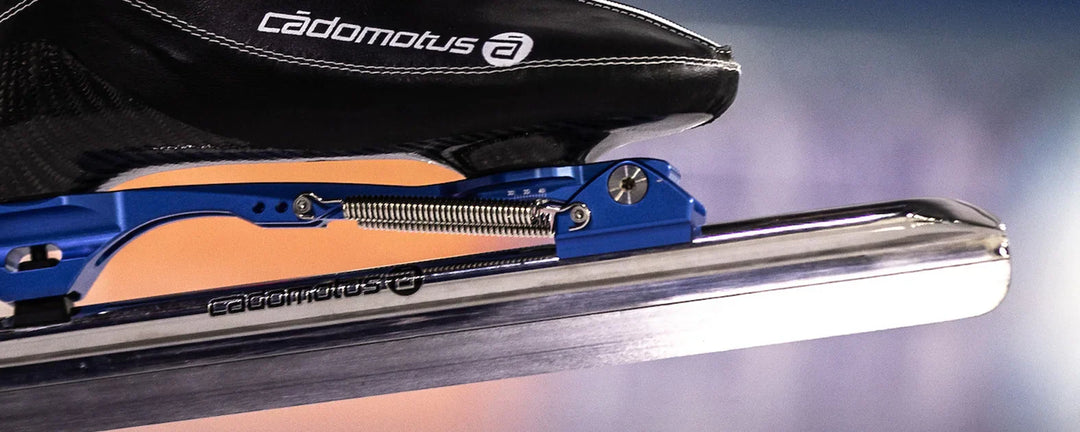
This is where the speedskating heritage truly changes the game. The Cádomotus World Cup T2 and Chronos Aero shoes use a tub‑style carbon shell with an exceptionally low stack height between the pedal axle and the sole of your foot.
Bringing your foot closer to the axle reduces the vertical lever arm. Theoretically, this can lower the stabilisation demands around the ankle and allow your calf muscles to work more economically during long bike legs. Those same muscles can then be used more effectively for what they are really needed to do in the run: storing and releasing elastic energy and driving you forward. For long‑distance triathletes, this redistribution of work is a highly plausible advantage.

Clinical and biomechanical work at the foot–shoe–pedal interface confirms that interventions which improve foot support and alignment can reduce unwanted movement and alter muscle recruitment. Combined with insights from running‑shoe research—that increased stack and instability tend to increase control demands and change gait patterns—this supports the idea that a lower, more stable platform under your foot can promote more efficient movement patterns, even if the exact performance gain in triathlon has not yet been fully quantified.
3. Lower Stack = Lower Saddle = Potential Aero Gain
A lower cycling‑shoe stack height triggers a chain reaction in your position. If you move to a shoe with a sole that is, for example, about 3–4 mm thinner than your previous model, you must lower your saddle by roughly the same amount to maintain your preferred knee extension.
Bike‑fit and EMG studies show that relatively small changes in saddle height can influence muscle activation patterns in the quadriceps, hamstrings, and calves. Staying within a narrow, individual “optimal zone” for saddle height appears important for both comfort and efficiency. Taking stack height seriously helps you stay within that zone instead of quietly pushing yourself too high as soles get thicker.

Lowering the saddle slightly also lowers your overall centre of mass and can reduce your frontal area (CdA) in certain positions. Aerodynamic field and tunnel tests on different positions and equipment commonly report gains of a few watts from small improvements in rider shape and height, although the exact number is highly rider‑ and setup‑dependent. A blanket “free 10 watts” cannot be stated as a universal scientific fact, but it is realistic to say that optimising stack and saddle height together can contribute to measurable aerodynamic and biomechanical efficiency gains for many athletes.
4. The Neuromuscular “Reset” into T2
The final piece of the puzzle is how quickly your nervous system can switch from “cycling mode” to “running mode.” Research on the bike‑to‑run transition in triathlon shows there is an adaptation phase in the first minutes of running where coordination, stride pattern, and perceived effort all change as the body reorganises its movement strategy.

In a shoe‑pedal setup where the foot moves and “searches” for stability on every pedal stroke, your lower leg muscles may have to constantly fine‑tune their output to keep you stable. A stiff, heat‑moldable carbon shell that wraps around the heel and midfoot can offload some of this stabilisation to the shoe structure itself, reducing the need for continuous low‑level muscle tension. This concept mirrors observations from both cycling and running research: more controlled, predictable support is often associated with more repeatable, economical movement patterns.
Although no controlled trial has yet proven that this type of cycling shoe cuts specific seconds off your 10 km split, it is neuromuscularly plausible that a more stable, lower‑stack platform on the bike makes it easier for your body to transition quickly into a smooth, mid‑foot oriented running pattern off the bike. Less “noise” in the system on the bike can mean a faster arrival at your natural rhythm once you hit the pavement.
Conclusion: Don’t Just Bike Fast—Protect Your Run
If you are consistently hitting your target bike splits yet struggling to find your “fresh legs” pace in the first 10 km of the run, it makes sense to look beyond power numbers and wheel depth and examine what is happening at the shoe–pedal interface.
Current evidence shows that changes in shoe and cleat setup clearly influence joint loading, muscle activation, and perceived comfort on the bike. Extrapolating these mechanisms to triathlon, there is a strong, science‑aligned rationale that a lower, more stable cycling‑shoe stack can help reduce unnecessary ankle work, refine your bike position, and potentially make the neuromuscular transition into the run smoother.
Choosing a shoe engineered with these biomechanics in mind—like the Chronos Aero Speedplay Triathlon Shoes, with a low stack height and supportive carbon shell—means you are not only optimising how you ride, but also giving yourself a better chance of running more efficiently and confidently after 180 km on the bike.
The research and background articles referenced in this blog are listed below for readers who want to dive deeper into the science behind these concepts.
Heel Stability: The Hidden Advantage That Can Save Your Marathon Run - https://cadomotus.com/blogs/cadowiki-triathlon/the-ironman-knee-and-the-hidden-power-of-heel-stability
Effect of cycling shoe cleat position on biomechanical and physiological responses during cycling – https://www.jsc-journal.com/index.php/JSC/article/view/521
The effects of cleat location on muscle recruitment – https://ojs.ub.uni-konstanz.de/cpa/article/view/5625/5119
Intervention at the foot–shoe–pedal interface in competitive cyclists – https://pmc.ncbi.nlm.nih.gov/articles/PMC4970853/
Interlink Between Physiological and Biomechanical Changes During the Bike–Run Transition in Triathlon – https://pmc.ncbi.nlm.nih.gov/articles/PMC9556684/
You’ve heard of “stack height” – but how does it apply to pedals and shoes? – https://www.cyclingweekly.com/products/youve-heard-of-stack-height-but-can-changing-it-boost-your-power-or-make-you-faster-we-took-a-detailed-look-to-see-how-it-all-stacks-up
The effects of running shoe stack height on running style and stability during level running – https://pmc.ncbi.nlm.nih.gov/articles/PMC11885301/
The effects of running shoe stack height on running style and stability during level running – journal version – https://www.frontiersin.org/journals/bioengineering-and-biotechnology/articles/10.3389/fbioe.2025.1526752/full
Footwear technology and biomechanical adaptations in running – https://www.frontiersin.org/journals/bioengineering-and-biotechnology/articles/10.3389/fbioe.2025.1642555/full
Aerodynamics test with the new Cadomotus triathlon cycling shoes – https://www.triathlonworld.nl/en/blogs/product-reviews/cadomotus-triatlon-fietsschoenen