Heel Stability: The Hidden Advantage That Can Save Your Marathon Run

- •The Real Culprit: That sharp knee pain on the run often starts on the bike. The knee is a “victim” joint — when your foot wobbles in the shoe, your tibia rotates and your knee pays the price over thousands of pedal strokes.
- •Why a Stiff Sole Isn’t Enough: A stiff plate still lets your heel tilt side to side. The fix is a wrap-around carbon shell that holds the heel in place — guiding your foot instead of just clamping it with a strap.
- •The Fix: Look for heel stability and a low stack height (our Chronos Aero sits at just 8.5 mm). A shorter lever to the pedal axle means less sideways wobble, smoother knee tracking, and a calmer base from the first km of the bike to the last km of the run.
Scroll down for the full breakdown of how your bike setup protects your knees on the run.
You’ve felt it before: 15 km into the marathon, a sharp pain starts to radiate from the outside of your knee. You blame your running shoes, your training volume, or your “weak glutes.” Yet in multisport, what happens on the bike can strongly influence how your knees feel once you start to run.
The knee as a “victim” joint
In cycling and running, the knee often behaves as a victim joint, positioned between the hip and the foot and reacting to what happens above and below it. Research and clinical bike-fit practice indicate that changes at the foot–shoe–pedal interface can alter tibial rotation and knee loading patterns.
If the foot is not well controlled in the shoe, small tilts or rotations can translate into extra stress for the structures around the knee over thousands of pedal strokes.
1. The “wobble” that costs you later
Most performance cycling shoes use a very stiff sole, but the way the heel and midfoot are held can still allow small side-to-side movements under load. When you push hard on the pedals, the rearfoot can tilt slightly inwards (pronation) or outwards, and the tibia follows with a degree of rotation.
This extra motion does not automatically cause injury, but it can contribute to less consistent knee tracking and increased strain in riders who are already on the edge with volume, intensity, or previous niggles.
A realistic chain reaction
- Heel and rearfoot motion can be linked with changes in tibial rotation.
- Tibial rotation is one factor that influences how the knee tracks and how load is distributed across joint structures.
- Over long rides and in fatigued states, this added “wobble” may contribute to the kind of lateral or anterior knee discomfort many triathletes recognize, especially when they then start to run.
2. Why a “tub” can beat a flat plate
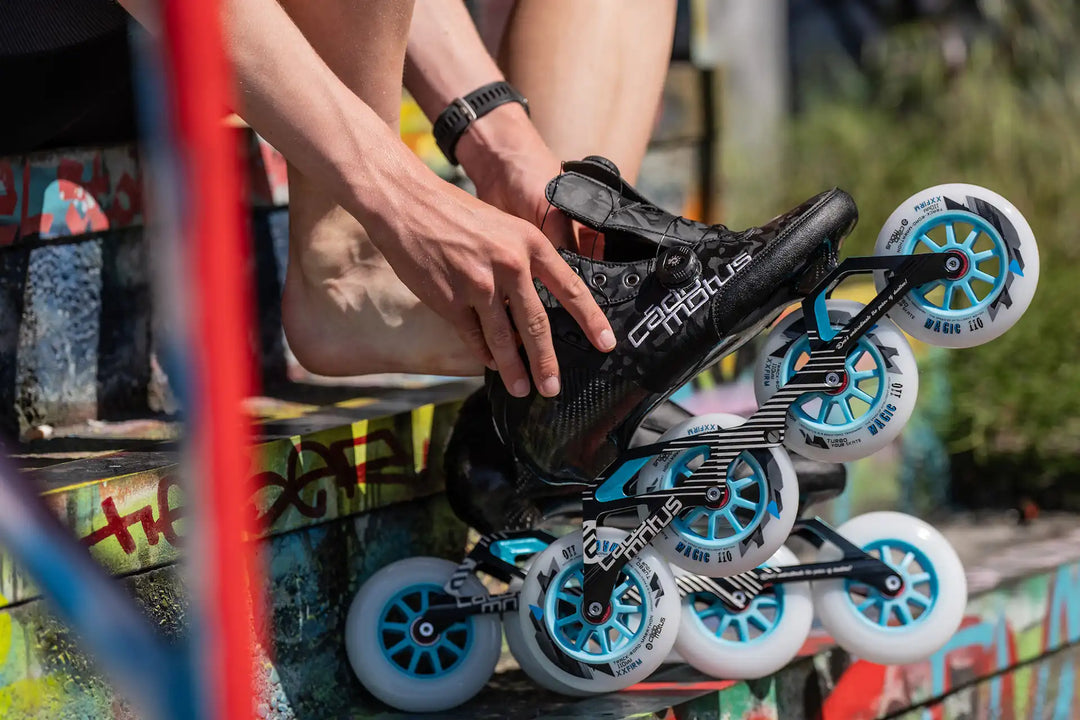
At Cádomotus, the focus is not only on a stiff carbon sole but on a monocoque carbon shell that wraps around the heel and sides of the foot. This design creates a kind of structural “tub” rather than just a flat plate with fabric on top.
The goal is to give the heel a more precise, mechanically supported position in the shoe, so that your foot is guided rather than merely compressed by straps or dials.

Traditional closure vs. wrap-around shell
- Traditional shoes rely heavily on straps or dials to pull the upper tight around the foot; security depends largely on how much pressure you apply.
- A wrap-around carbon shell provides rigid side walls that help limit unwanted rearfoot tilt, aiming to reduce excessive tibial rotation without completely blocking the natural, beneficial micro-movement needed for comfort.
This does not guarantee “perfect” alignment, because individual anatomy and bike fit still matter, but it is a design decision aimed at giving the heel a calmer, more stable environment under power.
3. Supporting the VMO, IT band and other stabilisers
Several muscles and soft-tissue structures help stabilise the knee, including the quadriceps, the medial portion often referred to as the VMO on the inner side, the iliotibial band on the outer side, and the hip musculature. Load or alignment imbalances can contribute to patellofemoral pain or iliotibial band problems in cyclists and runners.
When the foot and lower leg move more than necessary in the transverse and frontal planes, these stabilising tissues may be subjected to extra repetitive stress.
A shoe that gives the heel and midfoot a more consistent position on the pedal aims to:
- Reduce unnecessary corrective work from lateral structures such as the IT band by promoting smoother knee tracking.
- Help the quadriceps work in a more predictable pattern across the pedal stroke rather than constantly adapting to subtle shifts under the foot.
Current research does not yet quantify exactly how much a specific shoe model changes these loads in triathlon conditions, but the direction of the design is aligned with known principles of bike fit and lower-limb biomechanics.
4. The low-stack advantage
The Chronos Aero Speedplay edition uses an 8.5 mm stack height (pedal axle to foot), which is very low for a road/triathlon setup. A lower stack height shortens the lever arm between the point where force is applied and the pedal axle.
From a mechanical perspective, this can reduce the torque that tends to tip the shoe and heel sideways, in the same way that standing closer to the ground feels more stable than standing on a higher platform.

In practice, a low stack height can:
- Give a more direct, “connected” feeling between foot and pedal, which many athletes perceive as increased stability and control.
- Potentially reduce the magnitude of side-to-side leverage acting on the foot, supporting the goal of limiting unwanted heel wobble, especially during hard efforts and long rides.
While there is not yet definitive evidence that low pedal–shoe stack improves marathon times off the bike, its mechanical logic and rider feedback make it an attractive feature for triathletes seeking a stable base for high-volume, high-intensity work.
5. Stability as a performance feature
For triathletes, performance is not only about raw watts on the bike but also about how the body feels starting the run. A shoe that combines a stiff sole with a stable, wrap-around heel and low stack height is designed to provide efficient power transfer while minimising unnecessary motion at the foot–shoe–pedal interface.
This can offer a calmer environment for the knee and surrounding tissues over long distances, supporting consistent technique from the first kilometre of the bike to the last kilometres of the run.
The Cádomotus Chronos Aero and Chronos Aero Speedplay shoes are built with these principles in mind: using a monocoque carbon shell, precise heel hold and low stack height not only to enhance on-bike efficiency, but also to give multisport athletes a more stable platform for the demands of triathlon.
Want to dive deeper?
For readers who want to explore more background on cycling biomechanics, knee loading and shoe–pedal interfaces, see the following articles and reviews:
- The Overlooked Metric: Stack Height and Your Run off the Bike
- Intervention at the foot–shoe–pedal interface and its effects on lower-limb kinematics and kinetics in cycling.
-
Reviews and clinical overviews on cyclist’s knee and overuse knee injuries in cyclists.
- Research on custom orthoses, cleat setup and their impact on tibial rotation and knee joint loading.
- Clinical biomechanics of iliotibial band syndrome in endurance sports.
- Chapters and reviews on the general biomechanics of road cycling and bike fitting.