Every Second Counts: The Science of the Triathlon Transition

By Pablo Marcos Pazos, sport physiologist and biomechanist, ProEnduranceLab
When we look at triathlon as an elite sport, the transition is the fourth discipline, and many times it has become the one that decides the podium. Yet many athletes still treat it as a formality, something to get through between the "real" sports.
The numbers say otherwise. T1 and T2 together take barely 1.2% of an Olympic-distance race, yet the 2026 World Championship Grand Final in Pontevedra was won by 0.08 seconds, and Paris 2024 Olympic gold by 6 seconds, after Hayden Wilde struggled with his shoes in T2. Many of the athletes racing these short formats have stepped, or soon will step, into 70.3 and full distance, and the same logic follows them there.
Why a transition is more than a formality
Basically, because it decides which race you ride. Analysing elite races, Cejuela et al. (2013) already measured Lost Time: how much an athlete gives away against the riders they entered transition with. Lost Time in T1 and T2 correlated with final ranking (r = 0.43) more strongly than the raw split. A 2025 study of 113 WTS races and 5,051 elite performances found T1 in particular influences final position. The run decides most races; transitions decide which run you get: at the front, in the group, or chasing.
The key is that seconds become metres. At 40km/h one second equals 11 metres, well outside the slipstream. Closing it at 3km/h faster than the group takes about 13 seconds of solo, above-threshold riding, straight after the swim. That can mean saving the legs for the run, or not.
It still matters at 20 metres in longer events. Since 1 March 2026, Ironman and 70.3 professionals must ride 20m apart; age-groupers keep 12m. Ironman's own testing found 20m reduced, but did not remove, the aerodynamic benefit (220 Triathlon). CFD simulations put the drag reduction at about 9% at 20m in still air (Swiss Side, via Slowtwitch). When air resistance dominates, speed scales with the cube root of drag:
vtrain / vsolo = (1 / (1 − r))1/3
With r = 0.09, that is about 3% more speed for the same watts: around 7 minutes over an Ironman bike leg, 3.5 over a 70.3. Leave T1 ten seconds behind a legal train at 42 km/h and the gap is 117m. Closing it at 44 km/h takes about 3.5 minutes at 26% more aerodynamic power. Or you ride alone and pay those minutes back over the whole bike. Who gets in the shoe pedalling at full power makes a big difference.
What the 2026 championships show
Results below show combined T1 + T2, derived by taking away the other three segments from the total time (±1–2 s).
- Kona: Matthew Marquardt finished third, 56s behind Gustav Iden, after spending 1:23 longer in transition (6:10 vs 4:47) (TRI247).
- Nice 70.3 Worlds: Hayden Wilde beat Kristian Blummenfelt by 18s; 9s of that came from faster transitions, with about 27 men leaving the water together (TRI247).
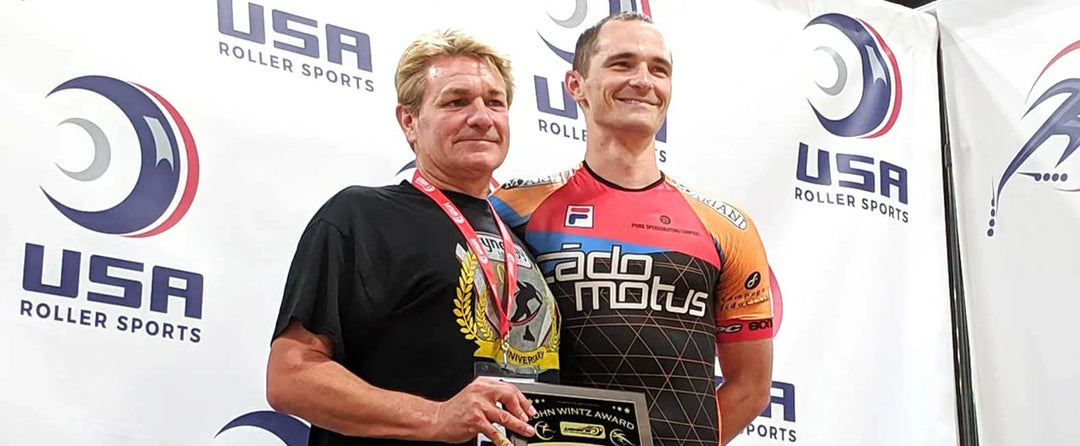
- Cádomotus athletes: Menno Koolhaas had the fastest transitions of the Kona top 20 (4:31, 10th overall). Sam Long was joint sixth fastest (4:49) on his way to 6th. In Nice, Rico Bogen (3:00) made the front bike group and entered T2 only 16s off the lead.
The first ten seconds on the bike
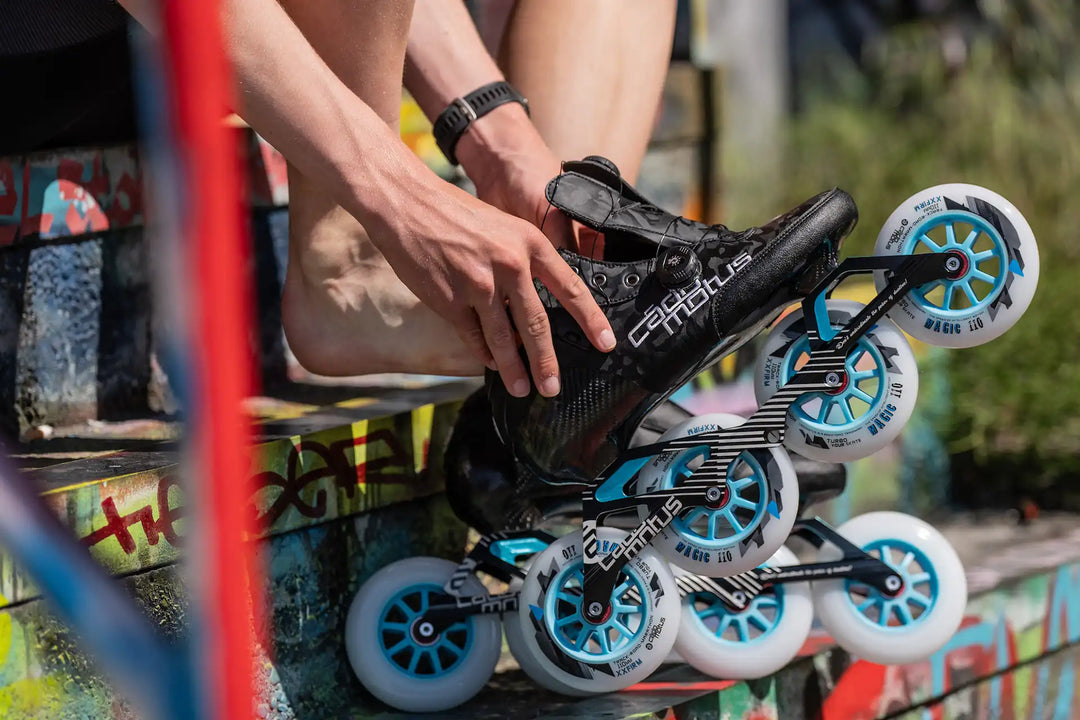
Elite athletes leave T1 barefoot, shoes clipped to the pedals and held by elastic bands. The decisive moment comes next: feet straight into the shoes, or pedalling on top first and sliding in later.
Those seconds are the most force-hungry of the whole bike. Taking an 80kg rider and bike from 18 to 45 km/h needs about 5,250J, roughly 525w for ten seconds before any air resistance. At 800w and 100rpm on a 172.5mm crank, the average effective pedal force is about 440N. All of it must pass through a shoe that is not yet fastened.
That is the engineering problem. A conventional shoe holds the foot by friction: strap tension presses it onto the sole, and the force it can carry along the sole is capped by:
F∥ ≤ μN
Unfastened, the clamping force N is close to zero, and wet skin lowers the friction coefficient μ. The foot slides, the heel rocks, and force goes sideways instead of into the crank. Pedalling on top of a closed shoe is even worse: it loads a flexible upper never designed to carry force, then costs more strokes as each foot goes in.
How Cádomotus shoes solve it
Cádomotus is known for building only triathlon shoes, using construction developed over 25 years of speed-skating boots. Each feature answers part of the problem above.
CarbonShell: shape instead of friction. The sole is a one-piece monocoque carbon "tub" that wraps up around the heel and midfoot, not a flat plate with an upper glued on. In engineering terms this is called form lock: the foot is held by the shape rather than clamping, so fore-aft and side-to-side loads are carried by the structure. That is why Cádomotus shoes transfer power before the closure is fully fastened (Cádomotus).
High carbon heel cup: support, stability and power from stroke one. The rigid heel captures the heel bone the moment the foot drops in.
- Support: the foot sits in a defined position without strap tension.
- Stability: the rearfoot cannot slide or rock on the downstroke, so less force is lost out of the plane of the crank. From a biomechanics point of view, this is measured as the index of effectiveness, the share of applied force that actually turns the crank; anything spent rocking the heel lowers it.
- Power: the athlete accelerates at full effort and fastens later, once settled in the group, without losing time and effort.
On the WorldCup T2 and new Synchros, the reinforced high-cut heel also keeps the opening firm and guides the foot in (Bike24), which makes direct entry even more forgiving for age-groupers.
Stiffness in every direction. Treat the shoe as a spring of stiffness k: the energy lost to deformation is
E = F2 / 2k
so doubling stiffness halves the loss. A flat plate is stiff only under the forefoot; a shell is stiff around the entire foot. The gap is largest before the shoe is tight.
Low stack height. The cleat sits close to the shell (6mm internal stack on the Chronos Aero, with a Wahoo Speedplay version mounted directly into the sole). A foot nearer the pedal axle has a shorter lever to rock on and shifts load from the calves to the hips and quads, leaving fresher legs for the run.
Built for the flying mount. The Chronos Aero and Synchros are shaped to sit horizontal on the bike when held by elastic bands, presenting the opening to the foot (Cádomotus).
Aero without the transition penalty. The Chronos Aero hides its dial under a zipped aero cover, with reported savings of 3–9 W in velodrome testing. In a conventional shoe, a zip and dial would cost time in T1. In a shell that already transfers power, closing it can wait until the athlete is in the train.
Heat-mouldable fit. The shell can be moulded at home to lock the heel and remove pressure points, which matters when feet are wet and sockless.
In short: the WorldCup T2 is built for sprint and draft-legal racing, where the fastest entry wins; the Chronos Aero and Synchro One for 70.3 and Ironman, where reaching the train first and staying aero for hours matters most.
Who benefits:
- Draft-legal and sprint athletes can sprint out of the mount zone to make the front pack, and close the shoe when it is safe, or even keep pedalling without closing it: fastening stops being a priority for efficiency.
- 70.3 and Ironman professionals reach train speed within the first hundred metres instead of chasing a 20m gap for minutes.
- Age-groupers get a forgiving entry: the heel cup holds its shape, and a half-secured foot still pushes on a stable platform. Energy saved on the bike is energy available for the run.
- Athletes who prefer to pedal on top first still gain: once the foot is in, power goes through the shell, so less time is spent fiddling with closures in a crowded mount zone.
Practical takeaways
- Train transitions like intervals: timed run-mount-accelerate repeats at race heart rate.
- Accelerate first, fasten second: in a shell shoe, get on the wheel or into the train before touching the shoe to close it.
- Progress your mount: learn and practise direct entry, putting your foot straight into the shoe and pedalling hard straight away.
- Measure Lost Time: film your exits and compare them with the athletes you entered with.
When world titles or championship classifications are decided by fractions of a second, the athletes who treat the transition as a discipline, and choose shoes built for it, start every run with an advantage.
Pablo Marcos Pazos is a sport physiologist, high-performance triathlon coach and founder of ProEnduranceLab.
As a consultant for brands, he helps develop products grounded in sport physiology and in how equipment really affects performance, through real-world athlete testing.
References
- Cejuela R, Cala A, Pérez-Turpin JA, Villa JG, Cortell JM, Chinchilla JJ (2013). Temporal activity in particular segments and transitions in the Olympic triathlon. Journal of Human Kinetics, 36, 87–95.
- Influence of triathlon segments and transitions on elite performance by distance and sex (2025). Journal of Human Kinetics.
- Race results: Pontevedra 2026 · Paris 2024 · Kona 2026 · Nice 70.3 2026 · Nice race report · Kona 2026 gear
- Draft rules and aerodynamics: Triathlon Magazine Canada, 20 m pro draft zone · 220 Triathlon, Ironman draft testing · Swiss Side CFD figures
- Product information: WorldCup T2 · Chronos Aero · Synchro One · Bike24, WorldCup T2 · Cádomotus athletes